Today's
EarthStation1.com 15% Off Commemorative Memorial Title: Complete
Classic TV Kid Shows Series MegaSet DVD, MP4 Download, USB
Today, May 23, 2026
May 23: National Taffy Day: -- An annual
celebration of a mouth-watering confection. Taffy candy has been
made and sold for many years and has become a favorite souvenir of
many vacationers. Salt water taffy (which does not incorporate sea
water, but rather uses salt in its recipe) was invented 1883 in
Atlantic City, New Jersey. Confectioners make this sweet treat
using boiled sugar and butter. They stretch and pull the
concoction until it is a chewy consistency that can be rolled and
cut. The flavors range from buttery to tart to sweet. There is a
flavor for everyone, and it seems like they introduce a new one
each year, too. Taffy's colorful displays entice children and
adults alike. And they have been doing so for generations. At one
time, candy shops and pharmacies sold penny candy, and taffy was
one of the many tempting options we could choose from. However,
those days are now long gone. With summer just around the corner,
seasonal candy shops are stocking up their latest selections. With
so many flavors to choose from, it's often hard to decide which
ones to pick. That's why they often offer flavors swirled together
to help us narrow it down. But we're still enticed by the variety
and the colors. To observe National Taffy Day, us it as the
perfect excuse to indulge in so sweet or tangy taffy! What is your
favorite flavor of taffy? Be sure to enjoy a piece or two. While
you're at it, share a favorite memory or send a box to someone you
know will enjoy some taffy. Give a shout-out to your favorite
candy shop, too! Use #NationalTaffyDay to post on social media. On
Sale @ 15% Off Discount Till Midnight PT!
https://store.earthstation1.com/4-disc-classic-tv-kid-shows-complete-dvd-se4.html
Today's
EarthStation1.com 15% Off Commemorative Memorial Title: Duck &
Cover & More! Nuclear War Information Films DVD, Download, USB
Today, May 23, 2026
May 23: World Turtle Day: -- Turtles and
tortoises are common sightings in parables, stories, and pop
culture, and we celebrate and honor these resilient animals.
Turtles and tortoises are associated with wisdom and perseverance.
They are reptiles that are found in many environments all around
the world. These creatures play an important role in their
respective ecosystems. They dig holes that are inhabited by other
creatures and keep our beaches clean by feeding on dead fish that
wash up on the shores. They maintain an ecological balance and,
therefore, it's important to conserve these gentle animals. It's
easy to get confused between a tortoise and turtle. The main
difference between the two is that turtles sometimes live in the
water, while tortoises only live on the land. Turtles live up to
the age of 40 and have streamlined and mostly flat shells. On the
other hand, tortoises can live up to 300 years and they have
larger, more domed shells. You will mostly find turtles in the
sea, while tortoises inhabit dense jungles and grasslands. Turtles
and tortoises are two different animals but this day is dedicated
to celebrating and protecting both. The day was first celebrated
by American Tortoise Rescue in 2002 and it highlights the
suffering and the dwindling numbers of these animals due to human
interference and environmental hazards. Schools, rescue centers,
and nature lovers all come together on this day to learn more
about these creatures and pledge their allegiance to help save
them. American Tortoise Rescue was created by Susan Tellem and
Marshall Thompson. They organize charity drives and actively work
to spread awareness for the critical conditions of these shelled
reptiles. The couple is known for their humane treatment of all
animals, including reptiles. Since its establishment in 1990,
American Tortoise Rescue has given homes to over 4,000 tortoises
and turtles. The organization also assists their local law
enforcement in guarding turtles' natural habitats and tending to
them when they are sick. On Sale @ 15% Off Discount Till Midnight
PT!
https://store.earthstation1.com/duck-and-cover-and-more-atomic-war-films-2-dual-layer-dvd2.html
Today's
EarthStation1.com 15% Off Commemorative Memorial Title: Let George
Do It Radio Crime Series DVD, MP3 Download, USB Flash Drive
Today, May 23, 2026
May 23: National Lucky Penny Day: -- It's
always nice to find a penny and on this day everyone is on the
lookout in the hopes of finding one lying around. The discovery of
pennies is often associated with good luck and celebrators believe
that if you find a penny on National Lucky Penny Day, you might
just be incredibly blessed! Nobody really knows how Lucky Penny
Day came to be about. Maybe that's exactly what makes the day so
fun (and lucky)! However, the first pennies in the U.S. were
minted from copper in 1793. The phrase "worth a penny"
may sound ridiculous to us today but there was once a time when a
penny held significant value. Over the years, the penny has lost
its value due to inflation and it's practically worthless now.
Nevertheless, it's always nice to find a penny when you aren't
looking for it! The Lucky Penny Day is also celebrated by those
who believe that pennies are lucky charms. They always keep an eye
on the ground to see if they will be fortunate enough to find a
lucky penny on this day. Pennies are believed to be harbingers of
good things and celebrated as a lucky item in many cultures! A
penny is usually the smallest unit of currency in many countries.
The present-day pennies were inspired by the ancient Roman
denarius and it wasn't until around 757 A.D. that pennies were
introduced in England. The first settlers took it to America and,
from 1793, America started minting its own pennies. On Sale @ 15%
Off Discount Till Midnight PT!
https://store.earthstation1.com/let-george-do-it-radio-mp3-dvd-complete-broadcast3.html
Today's
EarthStation1.com 15% Off Commemorative Memorial Title: The Story
Of Civilization: Will & Ariel Durant DVD, MP3 Download, USB
Today, May 23, 2026
May 23, 1707: #BOTD: #HBD! Carl Linnaeus,
also known after ennoblement in 1761 as Carl von Linne, Swedish
biologist, botanist, physician, and zoologist, known as the
"father of modern taxonomy" (the scientific study of
naming, defining [circumscribing] and classifying groups of
biological organisms based on shared characteristics) who
formalised binomial nomenclature (the formal system of naming
species of living things by giving each a name composed of two
parts, both of which use Latin grammatical forms), the modern
system of naming organisms (d. January 10, 1778) is #born in the
village of Rashult in Smaland, Sweden. Many of his writings were
in Latin; his name is rendered in Latin as Carolus Linnaeus and,
after his 1761 ennoblement, as Carolus a Linne. Linnaeus was the
son of a curate (a person who is invested with the care or cure
[cura] of souls of a parish). He received most of his higher
education at Uppsala University and began giving lectures in
botany there in 1730. He lived abroad between 1735 and 1738, where
he studied and also published the first edition of his Systema
Naturae in the Netherlands. He then returned to Sweden where he
became professor of medicine and botany at Uppsala. In the 1740s,
he was sent on several journeys through Sweden to find and
classify plants and animals. In the 1750s and 1760s, he continued
to collect and classify animals, plants, and minerals, while
publishing several volumes. By the time of his death in 1778, he
was one of the most acclaimed scientists in Europe. Linnaeus has
been called Princeps botanicorum (Prince of Botanists) and "The
Pliny of the North". He is also considered one of the
founders of modern ecology. In botany, the abbreviation L. is used
to indicate Linnaeus as the authority for a species' name. In
zoology, the abbreviation Linnaeus is generally used; the
abbreviations L., Linnaeus, and Linne are also used. In older
publications, the abbreviation "Linn." is found.
Linnaeus is designated as the type specimen for the human species,
Homo sapiens. Linnaeus was relieved of his duties in the Royal
Swedish Academy of Science in 1763, but continued his work there
as usual for more than ten years after. In 1769 he was elected to
the American Philosophical Society for his work. He stepped down
as rector at Uppsala University in December 1772, mostly due to
his declining health. Linnaeus's last years were troubled by
illness. He had had a disease called the Uppsala fever in 1764,
but survived due to the care of Rosen. He developed sciatica in
1773, and the next year, he had a stroke which partially paralysed
him. He had a second stroke in 1776, losing the use of his right
side and leaving him bereft of his memory; while still able to
admire his own writings, he could not recognise himself as their
author. In December 1777, he had another stroke which greatly
weakened him, and eventually led to his death on 10 January 1778
in Hammarby. Despite his desire to be buried in Hammarby, he was
buried in Uppsala Cathedral on 22 January. His library and
collections were left to his widow Sara and their children. Joseph
Banks, an eminent botanist, wished to purchase the collection, but
his son Carl refused the offer and instead moved the collection to
Uppsala. In 1783 Carl died and Sara inherited the collection,
having outlived both her husband and son. She tried to sell it to
Banks, but he was no longer interested; instead an acquaintance of
his agreed to buy the collection. The acquaintance was a
24-year-old medical student, James Edward Smith, who bought the
whole collection: 14,000 plants, 3,198 insects, 1,564 shells,
about 3,000 letters and 1,600 books. Smith founded the Linnean
Society of London five years later. The von Linne name ended with
his son Carl, who never married. His other son, Johannes, had died
aged 3. There are over two hundred descendants of Linnaeus through
two of his daughters. On Sale @ 15% Off Discount Till Midnight PT!
https://store.earthstation1.com/story-of-civilization-will-amp-ariel-durant-mp3-dvd-11-audiobo311.html
Today's
EarthStation1.com 15% Off Commemorative Memorial Title: The Story
Of Civilization: Will & Ariel Durant DVD, MP3 Download, USB
Today, May 23, 2026
May 23, 1734: #BOTD: #HBD! Franz Mesmer,
German physician, astrologer and astronomer who theorized the
existence of a process of natural energy transference occurring
between all animate and inanimate objects that he called "animal
magnetism" and was later referred to as mesmerism (d. March
5, 1815) is #born Franz Anton Mesmer in Iznang, Bishopric Of
Constance, Holy Roman Empire (now Moos, Baden-Wurttemberg,
Germany). Mesmer's theory attracted a wide following between about
1780 and 1850, and continued to have some influence until the end
of the 19th century. In 1843, the Scottish doctor James Braid
proposed the term "hypnotism" for a technique derived
from animal magnetism; today the word "mesmerism"
generally functions as a synonym of "hypnosis". Mesmer
also supported the arts, specifically music; he was on friendly
terms with Haydn and Mozart. Franz Mesmer died in the sovereign
state of Meersburg, Grand Duchy Of Baden (modern Baden, Germany)
aged 80. He is buried in the Friedhof Meersburg (Meersburg
Cemetery). On Sale @ 15% Off Discount Till Midnight PT!
https://store.earthstation1.com/story-of-civilization-will-amp-ariel-durant-mp3-dvd-11-audiobo311.html
Today's
EarthStation1.com 15% Off Commemorative Memorial Title: The
American Adventure: TV History Series 1607-1876 DVD MP4 USB Drive
Today, May 23, 2026
May 23, 1783: #DOTD: #RIP: James Otis
Jr., Founding Father Of The United States, Boston lawyer,
political activist, pamphleteer and legislator, early advocate of
the Patriot views against British policy that led to the American
Revolution, whose catchphrases "Taxation without
representation is tyranny" and "a man's house is his
castle" became the basic Patriot position (b. February 5,
1725) #dies a decade prior to the Declaration Of Independence when
Otis, who is reported to have said to his sister Mercy Otis Warren
"My dear sister, I hope, when God Almighty in his righteous
providence shall take me out of time into eternity that it will be
by a flash of lightning", is struck dead by lightning while
watching a thunderstorm from the doorway of a friend's home on May
23, 1783, aged 58. He is buried in The Granary Burying Ground of
Boston, Massachusetts. James Otis Jr. was born in West Barnstable,
Massachusetts. Otis was a fervent opponent of the writs of
assistance imposed by Great Britain on the American colonies in
the early 1760s that allowed law enforcement officials to search
property without cause. Otis was a mentor to Samuel Adams, and his
oratorical style inspired a young John Adams. Due to his early
influence in events leading up to the Revolution, Otis is
recognized as a Founding Father; however, Otis was plagued by
mental illness and alcoholism, and by the early 1770s, his erratic
behavior had rendered him inconsequential and embarrassing to the
cause; as a result, his role in the events leading up to the
Revolution have largely been forgotten. One of the most important
of these events occurred on June 21, 1768, when James Otis Jr.
offended the King and Parliament in a speech to the Massachusetts
General Court in a characteristically fiery speech to his fellow
legislators in Boston. He referred to the British House Of Commons
as a gathering of "button-makers, horse jockey gamesters,
pensioners, pimps, and whore-masters." The colony's royal
governor denounced Otis's tirade as the most "insolent. . .
treasonable declamation that perhaps was ever delivered."
Otis's speech in June 1768 was one of many that attacked
Parliament for its efforts to squeeze more revenue from the
American colonies. On Sale @ 15% Off Discount Till Midnight PT!
https://store.earthstation1.com/the-american-adventure-series-us-1st-century-4-dv14.html
Today's
EarthStation1.com 15% Off Commemorative Memorial Title: In Heaven
There Is No Beer Polka Culture USA MP4 Video Download DVD
Today, May 23, 2026
May 23, 1829: Aesthetics: The Performing
Arts: Music: Music History: Great Inventions: Musical Intruments:
The Accordion (German: Akkordeon, from Akkord [ie "Accord"],
"Musical Chord, Concord Of Sounds"): -- A patent is
granted to Austrian inventor of Armenian-Romanian origin Cyrill
Demian in Vienna, Austrian Empire. Cyrill Demian (b. 1772,
Szamosujvar (Gherla [Ancient Armenopolis], Transylvania - d. 1849,
Vienna, Austria) for what is contentiously considered the first
accordion. It was modification of the Handaoline (German: "Handy",
pronounced HAND-oh-leen-ah), and instrument patented in 1822 by
David Buschmann in Berlin, Germany, an instrument that had keys to
play individual notes, but no keys or buttons to play chords as
accordions do. On May 6, 1829, Cyrill Demian, an organ and piano
maker in Vienna, presented, along with his two sons Karl and
Guido, his accordion to the authorities to obtain a patent. The
patent was officially granted on May 23, 1829. Demian's instrument
bore little resemblance to modern instruments. It only had a left
hand button board, with the right hand simply operating the
bellows. One key feature for which Demian sought the patent was
the playing of an entire chord by depressing only one key. His
instrument also could sound two different chords with the same
key, one for each bellows direction (a bisonoric action). At that
time in Vienna, mouth harmonicas with Kanzellen (chambers) had
already been available for many years, along with bigger
instruments driven by hand bellows. The diatonic key arrangement
was also already in use on mouth-blown instruments. Demian's
patent thus presented a new instrument for accompanying singers or
other musicians: His accordion could be played with the right and
the left hand simultaneously, differend from the way that earlier
chromatic hand harmonicas were played, and was small and light
enough for travelers to carry. The patent also described
instruments with both bass and treble sections, although Demian
preferred the bass-only instrument, owing to its cost and weight
advantages. One of these instruments was given to the musical
instrument maker Johannes Dillner in Sweden by the Swedish
Princess Margareta Brahe in the late 1820s and is now privately
owned. The advent of the accordion is the subject of debate among
researchers.; some historians credit Christian Friedrich Ludwig
Buschmann as the inventor of the accordion; others give the
distinction to Cyrill Demian. Demian's invention comprised a small
manual bellows and five keys, although, as Demian noted in a
description of the instrument, extra keys could be incorporated
into the design. Numerous variations of the device soon followed.
Today, accordions constitute a family of box-shaped musical
instruments of the bellows-driven free reed aerophone type
(producing sound as air flows past a reed in a frame). The
essential characteristic of the accordion is to combine in one
instrument a melody section, also called the diskant, usually on
the right-hand keyboard, with an accompaniment or Basso continuo
functionality on the left-hand. The musician normally plays the
melody on buttons or keys on the right-hand side (referred to as
the keyboard or sometimes the manual), and the accompaniment on
bass or pre-set chord buttons on the left-hand side. A person who
plays the accordion is called an accordionist. The accordion
belongs to the free-reed aerophone family. Other instruments in
this family include the concertina, harmonica, and bandoneon. The
concertina and bandoneon do not have the melody-accompaniment
duality. The harmoneon is also related and, while having the
descant vs. melody dualism, tries to make it less pronounced. The
harmonium and American reed organ are in the same family, but are
typically larger than an accordion and sit on a surface or the
floor. The accordion is played by compressing or expanding the
bellows while pressing buttons or keys, causing pallets to open,
which allow air to flow across strips of brass or steel, called
reeds. These vibrate to produce sound inside the body. Valves on
opposing reeds of each note are used to make the instrument's
reeds sound louder without air leaking from each reed block. The
accordion is widely spread across the world because of the waves
of migration from Europe to the Americas and other regions. In
some countries (for example: Argentina, Brazil, Colombia, the
Dominican Republic, Mexico, and Panama) it is used in popular
music (for example: chamame in Argentina; gaucho, forro, and
sertanejo in Brazil; vallenato in Colombia; merengue in the
Dominican Republic; and norteno in Mexico), whereas in other
regions (such as Europe, North America, and other countries in
South America) it tends to be more used for dance-pop and folk
music. In Europe and North America, some popular music acts also
make use of the instrument. Additionally, the accordion is used in
cajun, zydeco, jazz, and klezmer music, and in both solo and
orchestral performances of classical music. Many conservatories in
Europe have classical accordion departments. The oldest name for
this group of instruments is harmonika, from the Greek harmonikos,
meaning "harmonic, musical". Today, native versions of
the name accordion are more common. These names refer to the type
of accordion patented by Cyrill Demian, which concerned
"automatically coupled chords on the bass side". On Sale
@ 15% Off Discount Till Midnight PT!
https://store.earthstation1.com/in-heaven-there-is-no-beer-polka-culture-usa-mp4-video-download-dv4.html
Today's
EarthStation1.com 15% Off Commemorative Memorial Title: Aviation
History Films Collection DVD MP4 Video Download
Today, May 23, 2026
May 23, 1848: #BOTD: #HBD! Otto
Lilienthal, German aviation pioneer, pilot and engineer nicknamed
"The Flying Man", the first person to make
well-documented, repeated, successful flights in an airplane (in
the form of an unpowered airplane known as gliders) (d. August 10,
1896) is #born Karl Wilhelm Otto Lilienthal in Anklam, Pomerania
Province, in the German kingdom of Prussia. Newspapers and
magazines published photographs of Lilienthal gliding, favorably
influencing public and scientific opinion about the possibility of
flying machines becoming practical. On August 9, 1896, his glider
stalled, and he was unable to regain control. Falling from about
15 m (50 ft), he broke his neck and died the next day, August 10,
1896, aged 48, in Berlin, Province of Brandenburg, Kingdom of
Prussia, German Empire. He is buried in Friedhof Lankwitz cemetery
in Lankwitz, Steglitz-Zehlendorf, Berlin, Germany. On Sale @ 15%
Off Discount Till Midnight PT!
https://store.earthstation1.com/aviation-history-films-2-dual-layer-dvd-se2.html
Today's
EarthStation1.com 15% Off Commemorative Memorial Title: Challenge
Of The Yukon Old Time Radio Series MP3 Set DVD Download USB
Today, May 23, 2026
May 23, 1873: Law Enforcement: Law
Enforcement: Law Enforcement In Canada: Law Enforcement Agencies:
Law Enforcement Agencies In Canada: The North-West Mounted Police
(NWMP) (The North-West Mounties): -- The Canadian Parliament
establishes The North-West Mounted Police, the forerunner of The
Royal Canadian Mounted Police (RCMP) ;(French: Gendarmerie Royale
Du Canada [GRC]). Made famous in America as "The North West
Mounties" in the Lieber & Stoller song "Searchin'"
by The Coasters, The North-West Mounted Police was established to
maintain order in the new Canadian North-West Territories (NWT)
following the 1870 transfer of Rupert's Land and North-Western
Territory to Canada from the Hudson's Bay Company, the Red River
Rebellion and in response to lawlessness, demonstrated by the
subsequent Cypress Hills Massacre and fears of United States
military intervention. The NWMP combined military, police and
judicial functions along similar lines to the Royal Irish
Constabulary. A small, mobile police force was chosen to reduce
potential for tensions with the United States and First Nations.
The NWMP uniforms included red coats deliberately reminiscent of
British and Canadian military uniforms. The NWMP was established
by the Canadian government during the ministry of Prime Minister
Sir John Macdonald who defined its purpose as "the
preservation of peace and the prevention of crime" in the
vast NWT. Macdonald envisioned the police force as a para-military
force, writing that the "best force would be mounted
riflemen, trained to act as cavalry... and styled police".
Macdonald's principal fear was that the activities of American
traders such as the Cypress Hills Massacre would lead to the First
Nations peoples killing the American traders, which would lead to
the United States military being deployed into the NWT to protect
the lives of American citizens under the grounds that Canada was
unable to maintain law and order in the region. Macdonald's
greatest fear was that if the Americans occupied the NWT that they
would not leave and the region would be annexed to the United
States. In 1874, the NWMP were deployed to the area of the present
Alberta border. Their ill-planned and arduous journey of nearly
900 miles (1,400 km) became known as the March West and was
portrayed as an epic journey of endurance. Over the next few
years, the NWMP established a wide network of forts, posts and
patrols and extended Canadian law across the region. The living
conditions of the NWMP on the prairies were spartan and often
uncomfortable, and only slowly improved over the course of the
century. By 1896, the government planned to pass policing
responsibilities to the provinces and ultimately disband the NWMP.
However, with the discovery of gold in the Klondike, the NWMP was
redeployed to protect Canada's sovereignty over the region and to
manage the influx of prospectors. NWMP volunteers were sent to
fight in the Second Boer War and, in recognition for that and 30
years of service policing the North-West and Yukon Territories,
King Edward VII, awarded the title Royal to the North-West Mounted
Police (RNWMP) in 1904. Plans for disbanding the Royal North-West
Mounted Police were abandoned in the face of popular oppositions
and regional politicians. Large numbers of the RNWMP volunteered
for military service during the First World War and the future of
the badly depleted force was once again in doubt. Towards the end
of the war, however, fears grew about a potential Bolshevik
conspiracy and the authorities tasked the RNWMP to investigate the
threat. In the aftermath of the violence of the Winnipeg General
Strike, the government amalgamated the RNWMP and Dominion Police,
to form the Royal Canadian Mounted Police (RCMP) in 1920. On Sale
@ 15% Off Discount Till Midnight PT!
https://store.earthstation1.com/challenge-of-the-yukon-mp3-dvd-complete-radio-broadcast3.html
Today's
EarthStation1.com 15% Off Commemorative Memorial Title: The
Private Life Of Don Juan 1934 Douglas Fairbanks DVD, Download, USB
Today, May 23, 2026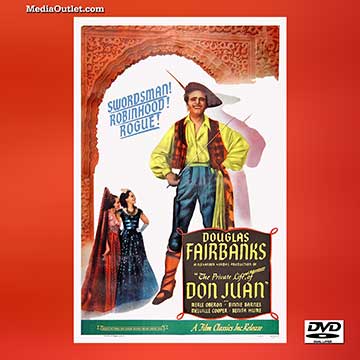
May 23, 1883: #BOTD: #HBD! Douglas
Fairbanks, pioneer Jewish American actor, director, producer,
stuntman and screenwriter who spent the early part of his career
making comedies and became best known for his swashbuckling roles
in silent films including The Thief Of Bagdad, Robin Hood, and The
Mark Of Zorro (d. December 12, 1939) is #born Douglas Elton Thomas
Ullman (spelled "Ulman" by Douglas Fairbanks Jr. in his
memoirs) in Denver, Colorado into a family of German Jewish
immigrants. He was renowned for his athleticism and for doing most
of his own stunts. Fairbanks was a founding member of United
Artists. Fairbanks was also a founding member of The Motion
Picture Academy and hosted the first Oscars Ceremony in 1929. With
his marriage to Mary Pickford in 1920, the couple became Hollywood
royalty and Fairbanks was referred to as "The King of
Hollywood", a nickname later passed on to actor Clark Gable.
Though widely considered as one of the biggest stars in Hollywood
during the 1910s and 1920s, Fairbanks' career rapidly declined
with the advent of the "talkies". His final film was The
Private Life of Don Juan (1934) with Merle Oberon. Douglas
Fairbanks died late in the day at his home in Santa Monica after
he suffered a heart attack, aged 56. His last words were
reportedly, "I've never felt better.". He is buried in
the Hollywood Forever cemetery in Hollywood, .California. On Sale
@ 15% Off Discount Till Midnight PT!
https://store.earthstation1.com/the-private-life-of-don-juan-dvd-douglas-fairbanks-merle-oberon.html
Today's
EarthStation1.com 15% Off Commemorative Memorial Title: The
African-American Civil War 54th Massachusetts Infantry DVD MP4 USB
Today, May 23, 2026
May 23, 1900: Awards And Decorations:
Awards And Decorations Of The United States Armed Forces: Highest
Military Awards For Gallantry: Highest Military Awards For
Gallantry Of The United States Armed Forces: The Medal Of Honor
(MOH) (The Congressional Medal Of Honor): The American Civil War
(The Civil War, The War Between The States): The Western Theater
Of The American Civil War: The Battles Of The Lower Seaboard
Theater And Gulf Approach Of The American Civil War: Operations
Against The Defenses Of Charleston During The American Civil War:
The Battles Of Fort Wagner: The Second Battle Of Fort Wagner (The
Second Assault On Morris Island; The Battle Of Fort Wagner, Morris
Island): -- African American Sergeant William Harvey Carney of the
African American 54th Regiment Massachusetts Volunteer Infantry,
which he had joined four months prior in March 1963, is awarded
the Medal Of Honor for his heroism in the July 18, 1863 assault on
Fort Wagner in Charleston, South Carolina. When the color guard (a
prestigious detachment of soldiers assigned to the protection of
regimental colours and the national flag) was killed, Carney
retrieved the U.S. flag and marched forward with it, despite
serious wounds. When the Union troops were forced to retreat under
fire, he struggled back across the battlefield, eventually
returning to his own lines and turning over the colors to another
survivor of the 54th, saying, "Boys, I only did my duty; the
old flag never touched the ground!" He was promoted from
private to sergeant in recognition of his heroism. This action for
which he received the Medal Of Honor preceded that of any other
African American Medal Of Honor recipient; however, his medal was
actually one of the last to be awarded for Civil War service.
Carney received his Medal Of Honor nearly 37 years after the
events at Fort Wagner (more than half of such awards from the
Civil War were presented 20 or more years after the fact). In
1901, shortly after his medal was awarded, a song was published
about his daring exploits: "Boys The Old Flag Never Touched
The Ground". William Harvey Carney (February 29, 1840 -
December 9, 1908) was born as a slave in Norfolk, Virginia. How he
made his way to freedom is not certain. According to most
accounts, he escaped through the Underground Railroad, and joined
his father in Massachusetts. Other members of their family were
freed by purchase or by the death of their master. After his
discharge, Carney returned to New Bedford, Massachusetts, and took
a job maintaining the city's streetlights. He spent a few years in
California, then returned again in 1869. He then delivered mail
for thirty-two years. He was a founding vice president of the New
Bedford Branch 18 of the National Association of Letter Carriers,
in 1890. He married Susannah Williams, and they had a daughter,
Clara Heronia. Carney died at the Boston City Hospital aged 68 of
complications from an elevator accident at the Massachusetts State
House, where he worked for the Department of State. His body lay
in repose for one day at the undertaking rooms of Walden Banks,
142 Lenox Street, at the wish of his wife and daughter. He was
buried in the family plot at Oak Grove Cemetery in New Bedford,
Massachusetts. Engraved on his tombstone is an image of the Medal
Of Honor. A New Bedford, Massachusetts, elementary school was
named in his honor, and his New Bedford home at 128 Mill Street is
listed on the National Register of Historic Places. His statue,
along with Private Milton L. Olive, is seen on the African
American Medal Of Honor Recipients Memorial in Wilmington,
Delaware. Sgt. Carney's statue is also prominently featured in his
hometown at West Point Cemetery (Norfolk, Virginia), atop a
monument to African American Civil War and Spanish American War
veterans. In 2015, Carney was honored as one of the Library of
Virginia's "Strong Men & Women in Virginia History"
because of his actions during the Civil War. On Sale @ 15% Off
Discount Till Midnight PT!
https://store.earthstation1.com/the-africanamerican-civil-war-54th-massachusetts-infantry-dvd-mp4-544.html
Today's
EarthStation1.com 15% Off Commemorative Memorial Title: The
Nuremberg Trials: Prosecution Of Nazi War Crimes MP4 Download DVD
Today, May 23, 2026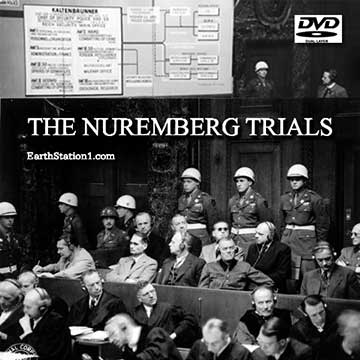
May 23, 1900: #BOTD: Hans Frank, German
politician, lawyer, war criminal and holocaust perpetrator who
served as head of the General Government in Nazi-occupied Poland
during the Second World War (d. October 16, 1946) is #born Hans
Michael Frank in Karlsruhe, Germany. Frank was an early member of
the German Workers' Party, the precursor of the Nazi Party
(NSDAP). He took part in the failed Beer Hall Putsch, and later
became Adolf Hitler's personal legal adviser as well as the lawyer
of the NSDAP. In June 1933, he was named as a Reichsleiter (Reich
Leader) of the party. In December 1934, Frank joined the Hitler
Cabinet as a Reichsminister without portfolio. After the German
Invasion Of Poland in 1939, Frank was appointed Governor-General
of the occupied Polish territories. During his tenure, he
instituted a reign of terror against the civilian population and
became directly involved in the mass murder of Jews. He engaged in
the use of forced labour and oversaw four of the extermination
camps. Frank remained head of the General Government until its
collapse in early 1945. After the war, Frank was found guilty of
war crimes and crimes against humanity at the Nuremberg trials. He
was sentenced to death and executed by hanging. His remains were
cremated, and the ashes were scattered into the
Wenzbach/Conwentzbach, a small stream in Munich, Germany. On Sale
@ 15% Off Discount Till Midnight PT!
https://store.earthstation1.com/the-nuremberg-trials-prosecution-of-nazi-war-crimes-mp4-download-dv4.html
Today's
EarthStation1.com 15% Off Commemorative Memorial Title: The Old
Time Radio Music MP3 MegaSet DVD, Audio Download, USB Stick
Today, May 23, 2026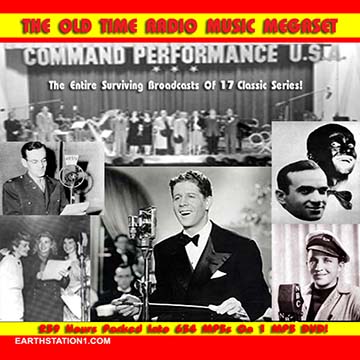
May 23, 1910: #BOTD: #HBD! Artie Shaw,
American clarinetist, composer, bandleader, actor, writer and
novelist, Widely regarded one of jazz's best clarinetists (d.
December 30, 2004) is #born Arthur Jacob Arshawsky in New York
City an Austrian Jewish immigrant mother and a Russian Jewish
immigrant father. Shaw led one of the United States' most popular
big bands in the late 1930s through the early 1940s. Though he had
numerous hit records, he was perhaps best known for his 1938
recording of Cole Porter's "Begin the Beguine." Prior to
the release of "Beguine," Shaw and his fledgling band
had languished in relative obscurity for over two years and, after
its release, he became a major pop artist within short order. The
record eventually became one of the era's defining recordings.
Musically restless, Shaw was also an early proponent of what
became known much later as Third Stream music, which blended
elements of classical and jazz forms and traditions. His music
influenced other musicians, such as John Barry in England, with
the vamp of the James Bond Theme, possibly influenced by
"Nightmare," which also has a similar vamp to Kurt
Weill's "Lonely House." Shaw also recorded with small
jazz groups drawn from within the ranks of the various big bands
he led. In addition to hiring Buddy Rich, he signed Billie Holiday
as his band's vocalist in 1938, becoming the first white band
leader to hire a full-time black female singer to tour the
segregated Southern U.S. However, after recording "Any Old
Time," Holiday left the band due to hostility from audiences
in the South, as well as from music company executives who wanted
a more "mainstream" singer. Shaw's band became
enormously successful, and his playing was eventually recognized
as equal to that of Benny Goodman. Longtime Duke Ellington
clarinetist Barney Bigard cited Shaw as his favorite clarinet
player. In response to Goodman's nickname, the "King of
Swing," Shaw's fans dubbed him the "King of the
Clarinet." Shaw felt the titles should be reversed. "Benny
Goodman played clarinet. I played music," he said. In 1938,
Down Beat magazine readers voted Artie Shaw's the best swing band.
He served in the US Navy from 1942 to 1944, (during which time he
led a morale-building band that toured the South Pacific amidst
the chaos of World War II) and, following his discharge in 1944,
he returned to lead a band through 1945. Following the breakup of
that band, he began to focus on other interests and gradually
withdrew from the world of being a professional musician and major
celebrity, although he remained a force in popular music and jazz
before retiring from music completely in 1954. Shaw credited his
time in the Navy from 1942 to 1944 as a period of renewed
introspection.[5] After his discharge, he entered psychoanalysis
and began to gradually withdraw from music to pursue a writing
career. His autobiography, The Trouble With Cinderella: An Outline
of Identity, was published in 1952 (with later reprint editions in
1992 and 2001). Revealing downbeat elements of the music business,
Shaw explained that "the trouble with Cinderella" is
"nobody ever lives happily ever after." He turned to
semi-autobiographical fiction with the three short novels in I
Love You, I Hate You, Drop Dead! (1965, reprinted in 1997), which
prompted Terry Southern's comment: "Here is a deeply probing
examination of the American marital scene. I flipped over it!".
Shaw's short stories, including "Snow White in Harlem,"
were collected in The Best of Intentions and Other Stories (1989).
He worked for years on his 1000-page autobiographical novel, The
Education of Albie Snow, but the three-volume work remained
unpublished. Currently, through Curtis International Associates,
the Artie Shaw Orchestra is still active. Artie Shaw died in
Thousand Oaks, California, aged 94. According to his publicist, he
had been "in ill health for some time, but I don't know the
specific cause of death." Shaw had been diabetic since the
1980s. He is buried in Pierce Brothers Valley Oaks Memorial Park
cemetery in Westlake Village, Los Angeles County, California. On
Sale @ 15% Off Discount Till Midnight PT!
https://store.earthstation1.com/the-old-time-radio-music-megaset-dual-layer-mp3-dv3.html
Today's
EarthStation1.com 15% Off Commemorative Memorial Title: New York
City History Documentary Collection MP4 Video Download DVD
Today, May 23, 2026
May 23, 1911: Dedications: Library
Dedications: -- The New York Public Library Main Branch in Bryant
Park, Manhattan is dedicated. The New York Public Library (NYPL)
is a public library system in New York City. With nearly 53
million items and 92 locations, the New York Public Library is the
second largest public library in the United States (behind the
Library of Congress) and the third largest in the world. It is a
private, non-governmental, independently managed, nonprofit
corporation operating with both private and public financing. The
library has branches in the boroughs of Manhattan, the Bronx, and
Staten Island and affiliations with academic and professional
libraries in the New York metropolitan area. The city's other two
boroughs, Brooklyn and Queens, are not served by the New York
Public Library system, but rather by their respective borough
library systems: the Brooklyn Public Library and the Queens Public
Library. The branch libraries are open to the general public and
consist of circulating libraries. The New York Public Library also
has four research libraries, which are also open to the general
public. The library, officially chartered as The New York Public
Library, Astor, Lenox and Tilden Foundations, was developed in the
19th century, founded from an amalgamation of grass-roots
libraries and social libraries of bibliophiles and the wealthy,
aided by the philanthropy of the wealthiest Americans of their
age. The "New York Public Library" name may also refer
to its Main Branch, which is easily recognizable by its lion
statues named Patience and Fortitude that sit either side of the
entrance. The branch was declared a National Historic Landmark in
1965, listed on the National Register of Historic Places in 1966,
and designated a New York City Landmark in 1967. On Sale @ 15% Off
Discount Till Midnight PT!
https://store.earthstation1.com/new-york-city-history-videos-3-dvd-se3.html
Today's
EarthStation1.com 15% Off Commemorative Memorial Title: World War
1 TV Series With Robert Ryan DVD, Video Download, USB Drive
Today, May 23, 2026
May 23, 1915: The European Civil War:
World War I: The First European War (The European Theater Of World
War I): World War I Treaties: The Treaty Of London (Italian:
Trattato Di Londra) (The Pact Of London [Italian: Patto Di
Londra], Officially "Agreement Between France, Russia, Great
Britain And Italy. Signed At London April 26, 1915"): -- In
fulfillment of its obligations under the treaty, Italy joins the
Allies in fighting the Central Powers of World War I. The London
Pact was a secret pact between the Triple Entente and the Kingdom
of Italy. was signed in London on April 26, 1915 by the United
Kingdom of Great Britain and Ireland, the French Third Republic,
the Russian Empire, and the Kingdom Of Italy. Its intent was to
gain the alliance of Italy against its former allies, including
the German Empire and Austria-Hungary. The main lure was promising
large swaths of Austria-Hungary to the north of Italy and to the
east across the Adriatic. Britain also promised funding. Italy
promised to enter the war the next month. The Allies could easily
outbid Austria-Hungary and thereby won a military alliance with 36
million Italians. The secret provisions were published by the
Bolsheviks when they came to power in Russia in late 1917. On Sale
@ 15% Off Discount Till Midnight PT!
https://store.earthstation1.com/world-war-1-robert-ryan-4-dual-layer-dvds-26-episode-tv-se1426.html
Today's
EarthStation1.com 15% Off Commemorative Memorial Title: Forty
Years Of Fine Tuning (1984) WNEW TV Channel 5 DVD, Download, USB
Today, May 23, 2026
May 23, 1928: #BOTD: #HBD! Rosemary
Clooney, American singer, actress and beauty (d. June 29, 2002) is
#born Rose Mary Clooney in Maysville, Kentucky. Rose M. Clooney
She came to prominence in the early 1950s with the song "Come
On-a My House", which was followed by other pop numbers such
as "Botch-a-Me", "Mambo Italiano", "Tenderly",
"Half as Much", "Hey There" and "This Ole
House". She also had success as a jazz vocalist. Clooney's
career languished in the 1960s, partly due to problems related to
depression and drug addiction, but revived in 1977, when her White
Christmas co-star Bing Crosby asked her to appear with him at a
show marking his 50th anniversary in show business. She continued
recording until her death in 2002. Rosemary Clooney died of lung
cancer at her Beverly Hills, California home, aged 74. Her nephew,
George Clooney, was a pallbearer at her funeral. She is buried at
Saint Patrick's Cemetery, Maysville, Kentucky, the town in which
she was born. On Sale @ 15% Off Discount Till Midnight PT!
https://store.earthstation1.com/forty-years-of-fine-tuning-dvd-wnew-tv-channel-5-ny5.html
Today's
EarthStation1.com 15% Off Commemorative Memorial Title: G-Men: The
Rise Of J. Edgar Hoover DVD, Video Download, USB Drive
Today, May 23, 2026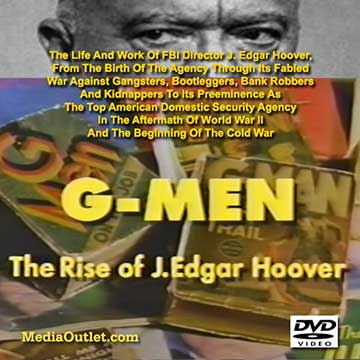
May 23, 1934: Crime: Organized Crime:
Organized Crime In The United States: Gangsters: American
Gangsters: Bonnie And Clyde (Bonnie Elizabeth Parker And Clyde
Chestnut "Champion" Barrow): -- #DOTD: Infamous American
bank robbers Bonnie Parker and Clyde Barrow, notoriously known as
Bonnie And Clyde, #dies when they are ambushed by police and
killed in Bienville Parish, Louisiana. She is buried at Crown Hill
Memorial Park cemetery in Dallas, Texas; he is buried at Western
Heights Cemetery in Dallas, Texas. Bonnie Elizabeth Parker (b.
October 1, 1910) and Clyde Chestnut Barrow also known as Clyde
Champion Barrow (b. March 24, 1909) were American criminals who
traveled the central United States with their gang during the
Great Depression, robbing people and killing when cornered or
confronted. Their exploits captured the attention of the American
public during the "Public Enemy Era," between 1931 and
1935. Though known today for their dozen-or-so bank robberies, the
duo most often preferred to rob small stores or rural gas
stations. The gang is believed to have killed at least nine police
officers and several civilians. The couple were eventually
ambushed and killed by law officers near Sailes, Bienville Parish,
Louisiana. Their exploits were revived and cemented in American
pop folklore by Arthur Penn's 1967 film Bonnie And Clyde. On Sale
@ 15% Off Discount Till Midnight PT!
https://store.earthstation1.com/gmen-the-rise-of-j-edgar-hoover-dvd.html
Today's
EarthStation1.com 15% Off Commemorative Memorial Title: Brother,
Can You Spare A Dime? (1975) DVD, Video Download, USB Drive
Today, May 23, 2026
May 23, 1934: Labor Union Disputes (Trade
Union Disputes): Strikes (Strike Actions, Labor Strikes, Labour
Strikes): The Toledo Auto-Lite Strike (The Battle Of Toledo): -- A
five-day fight between 1,300 troops of the Ohio National Guard and
6,000 picketers occurs, the culmination of The Auto-Lite Strike
known as "The Battle Of Toledo", a five-day running
battle that left two strikers dead and more than 200 injured. The
Toledo Auto-Lite Strike, one of the most important labor strikes
in U.S. history, began on April 12, 1934 as a strike by a federal
labor union of the American Federation Of Labor (AFL) against the
Electric Auto-Lite company of Toledo, Ohio. It lasted until June
3, 1934, and all told, in involved 10,000 strikers and 1,300
members of the Ohio National Guard. On Sale @ 15% Off Discount
Till Midnight PT!
https://store.earthstation1.com/brother-can-you-spare-a-dime-1975-great-depression-films1975.html
Today's
EarthStation1.com 15% Off Commemorative Memorial Title: I Want My
Music TV! 1980s Music Television Videos MP4 Download DVD Set
Today, May 23, 2026
May 23, 1934: #BOTD: #HBD! Robert Moog,
American engineer, electronic music pioneer and businessman,
inventor of the Moog synthesizer (d. August 21, 2005) is #born
Robert Arthur Moog at Flushing Hospital in New York City to George
Conrad Moog, of German descent, and Shirley (Jacobs) Moog, of
Polish-Jewish descent. He was raised in Flushing, Queens. He was
the founder of the synthesizer manufacturer Moog Music and the
inventor of the first commercial synthesizer, the Moog
synthesizer, which debuted in 1964. In 1970, Moog released a more
portable model, the Minimoog, described as the most famous and
influential synthesizer in history. Among Moog's honors are a
Technical Grammy Award, received in 2002, and an induction into
the National Inventors Hall of Fame. By 1963, Moog had been
designing and selling theremins for several years while working
toward a PhD in engineering physics at Cornell University. He
developed his synthesizer in response to demand for more practical
and affordable electronic-music equipment, guided by suggestions
and requests from composers. Moog's principal innovation was the
voltage-controlled oscillator, which uses voltage to control
pitch. He also introduced fundamental synthesizer concepts such as
modularity, envelope generation and the pitch wheel. He is
credited with introducing synthesizers to a wider audience and
influencing the development of popular music. Moog pursued his
work as a hobby, and he is regarded as a poor businessman. His
only patent was on his transistor ladder filter design;
commentators have speculated that he would have become extremely
wealthy had he patented his other innovations, but that their
availability in the public domain helped the synthesizer industry
flourish. In 1971, Moog sold Moog Music to Norlin Musical
Instruments, where he remained as a designer until 1977. In 1978,
he founded the company Big Briar, and in 2002 he renamed it Moog
Music after reacquiring the rights to the name. In later years,
Moog taught at the University of North Carolina at Asheville and
continued designing instruments for the revived Moog Music. He
died at the age of 71 in Asheville, North Carolina from a brain
tumor. He is buried at Lou Pollock Memorial Park cemetery in
Asheville. On Sale @ 15% Off Discount Till Midnight PT!
https://store.earthstation1.com/i-want-my-music-tv-dvd-late-1980s-vi1980.html
Today's
EarthStation1.com 15% Off Commemorative Memorial Title: The
Sinking & Rescue Of The USS Squalus DVD, MP4 Download, USB
Drive
Today, May 23, 2026
May 23, 1939: Naval History: The History
Of The United States Navy: The New United States Navy (The New
Navy, The United States Navy 1885-Present): United States Navy:
Maritime Incidents: Naval Maritime Incidents: The Sinking Of The
USS Squalus: #DOTD: #RIP: -- U.S. Navy submarine USS Squalus
(SS-192) sinks off the coast of New Hampshire during a test dive,
causing the death of 24 sailors and two civilian technicians. The
remaining 32 sailors and one civilian naval architect are rescued
the following day. Four enlisted divers, Chief Machinist's Mate
William Badders, Chief Boatswain's Mate Orson L. Crandall, Chief
Metalsmith James H. McDonald and Chief Torpedoman John Mihalowski,
were awarded the Medal Of Honor for their work during the rescue
and subsequent salvage. On May 12 1939, following a yard overhaul,
Squalus began a series of test dives off Portsmouth, New
Hampshire. After successfully completing 18 dives, she went down
again off the Isles of Shoals on the morning of May 23. Failure of
the main induction valve caused the flooding of the aft torpedo
room, both engine rooms, and the crew's quarters, drowning 26 men
immediately. Quick action by the crew prevented the other
compartments from flooding. Squalus bottomed in 243 ft (74 m) of
water. Squalus was initially located by her sister ship, Sculpin.
The two submarines were able to communicate using a telephone
marker buoy until the cable parted. Divers from the submarine
rescue ship Falcon began rescue operations under the direction of
the salvage and rescue expert Lieutenant Commander Charles B.
"Swede" Momsen, using the new McCann Rescue Chamber. The
Senior Medical Officer for the operations was Dr. Charles Wesley
Shilling. Overseen by researcher Albert R. Behnke, the divers used
recently developed heliox diving schedules and successfully
avoided the cognitive impairment symptoms associated with such
deep dives, thereby confirming Behnke's theory of nitrogen
narcosis. The divers were able to rescue all 33 surviving crew
members from the sunken submarine. The navy authorities felt it
important to raise her as she incorporated a succession of new
design features. With a thorough investigation of why she sank,
more confidence could be placed in the new construction, or
alteration of existing designs could be undertaken when cheapest
and most efficient to do so. Furthermore, given similar previous
accidents in Sturgeon and Snapper (indeed, in S-5, as far back as
1920), it was necessary to determine a cause. The salvage of
Squalus was commanded by Rear Admiral Cyrus W. Cole, Commander of
the Portsmouth Naval Shipyard, who supervised salvage officer
Lieutenant Floyd A. Tusler from the Construction Corps. Tusler's
plan was to lift the submarine in three stages to prevent it from
rising too quickly, out of control, with one end up, in which case
there would be a high likelihood of it sinking again. For 50 days,
divers worked to pass cables underneath the submarine and attach
pontoons for buoyancy. On July 13, 1939, the stern was raised
successfully, but when the men attempted to free the bow from the
hard blue clay, the vessel began to rise far too quickly, slipping
its cables. Ascending vertically, the submarine broke the surface,
and 30 feet (10 m) of the bow reached into the air for not more
than ten seconds before she sank once again all the way to the
bottom. Momsen said of the mishap, "pontoons were smashed,
hoses cut and I might add, hearts were broken." After 20 more
days of preparation, with a radically redesigned pontoon and cable
arrangement, the next lift was successful, as were two further
operations. Squalus was towed into Portsmouth on September 13, and
decommissioned on November 15. A total of 628 dives had been made
in rescue and salvage operations. Renamed Sailfish on February 9,
1940, she became the first ship of the U.S. Navy named for the
sailfish. After reconditioning, repair, and overhaul, she was
recommissioned on May 15, 1940 with Lieutenant Commander Morton C.
Mumma, Jr. (Annapolis, Class of 1930) in command. With refit
completed in mid-September, Sailfish departed Portsmouth on
January 16, 1941 and headed for the Pacific. Transiting the Panama
Canal, she arrived at Pearl Harbor in early March, after refueling
at San Diego. The submarine then sailed west to Manila where she
joined the Asiatic Fleet until the attack on Pearl Harbor. During
the Pacific War, the captain of the renamed ship issued standing
orders if any man on the boat said the word "Squalus",
he was to be marooned at the next port of call. This led to crew
members referring to their ship as "Squailfish". That
went over almost as well; a court martial was threatened for
anyone heard using it. The USS Sailfish (SS-192) conducted twelve
successful patrols in the Pacific War during World War II, sinking
numerous Imperial Japanese vessels. On Sale @ 15% Off Discount
Till Midnight PT!
https://store.earthstation1.com/the-sinking-amp-rescue-of-the-uss-squalus-dvd-mp4-usb-flash-driv4.html
Today's
EarthStation1.com 15% Off Commemorative Memorial Title: Tibet
History & The Dalai Lama Documentaries DVD, MP4, USB Drive
Today, May 23, 2026
May 23, 1951: Tibet: The History Of
Tibet: The Aftermath Of World War II: The Cold War: The Cold War
In Asia: The Annexation Of Tibet By The People's Republic Of
China: The Seventeen Point Agreement (The Seventeen Point
Agreement For The Peaceful Liberation Of Tibet, The Agreement Of
The Central People's Government And The Local Government Of Tibet
On Measures For The Peaceful Liberation Of Tibet): --
Plenipotentiaries of the Central People's Government and delegates
of the leader of Tibet, the 14th Dalai Lama Tenzin Gyatso, sign
the Seventeen Point Agreement in Zhongnanhai, Beijing, China, a
document regarded in China as a legal contract which China asserts
was mutually welcomed by both governments. The United States
responded by secretly informing The Dalai Lama that "Your
Holiness will understand, of course, that the readiness of the
United States to render you the assistance and support... is
conditional upon your departure from Tibet, upon your public
disavowal of agreements concluded under duress between the
representatives of Tibet and those of the Chinese Communist
aggression.". Following on this, The 14th Dalai Lama ratified
the agreement only in the form of a telegraph some six months
later, on October 24, 1951, but it took some eight more years for
the agreement to be legally reputiated by His Holiness and Tibet
on March 11, 1959 when he escaped The 1959 Tibetan Uprising with
the assistance of the CIA. Following his successful escape from
Tibet and arrival in India on March 19, 1959, the 14th Dalai Lama
further repudiated the agreement on April 18, 1959, when he issued
a statement declaring that the agreement was made under duress,
and again reputiated the agreement on June 20 at a press
conference. The Central Tibetan Administration which was formed
after 1960, and international law expert Eckart Klein, consider it
invalid and as having been signed under duress; however, Ngapoi
Ngawang Jigme, who led the Tibetan delegation during the
agreement's negotiations, reported that there was no duress
involved. The validity of the agreement continues to be a source
of controversy, and the 14th Dalai Lama has since repudiated the
agreement on many occasions. As of 2026, The Dalai Lama continues
to live as a refugee. On Sale @ 15% Off Discount Till Midnight PT!
https://store.earthstation1.com/tibet-documentaries-2-dvd-se2.html
Today's
EarthStation1.com 15% Off Commemorative Memorial Title: Vietnam:
The Ten Thousand Day War TV Series DVD, Video Download, USB
Today, May 23, 2026
May 23, 1959: The Aftermath Of World War
II: The Cold War: The Cold War In Asia: The Indochina Wars: The
Laotian Civil War (The Secret War): -- The sixteen-year civil war
in Laos begins as 1,500 troops of the Pathet Lao (Laoation: "The
'Lao Nation" (The Lao People's Liberation Arm)y, backed up by
a deployment of about 30,000-40,000 North Vietnamese Army soldiers
assembled to penetrate northern Laos, refused to be integrated
into the Royal Lao Army by order of the left-wing Lao Patriotic
Front leader Prince Souphanouvong.(The Red Prince) the day prior.
Souphanouvong was then arrested and imprisoned, along with his
aides. The two Pathet Lao battalions, one after the other, escaped
during the night with no shots fired, taking their equipment,
families, and domestic animals with them. On 23 May, Souphanouvong
and his companions also escaped unscathed, sparking the war
between the Communist Pathet Lao and the Royal Lao Government. The
Laotian Civil War (May 23, 1959 to December 2, 1975) is associated
with the Cambodian Civil War and the Vietnam War, with both sides
receiving heavy external support in a proxy war between the global
Cold War superpowers. It is called The Secret War among the
American CIA Special Activities Center, and Hmong and Mien
veterans of the conflict. The Kingdom of Laos was a covert theater
for other belligerents during the Vietnam War as well. On October
22, 1953, The Franco-Lao Treaty Of Amity And Association was
signed, transferring remaining French powers in Laos to The Royal
Lao Government (except control of military affairs) and
establishing Laos as an independent member of the French Union.
However, this government did not include representatives from the
Lao Issara, an armed anti-French, anti-colonial nationalist
movement led by Prince Phetsarath (Phetsarath Ratanavongsa) that
was the government of Laos before the return of the French and had
disbanded in in principle in 1949. The following years of The
Royal Lao Government (1947-1975) were marked by a rivalry between
the neutralists under Prince Souvanna Phouma, the right wing under
Prince Boun Oum of Champassak, and the left-wing Lao Patriotic
Front under Prince Souphanouvong and half-Vietnamese future Prime
Minister Kaysone Phomvihane, the first leader of the Communist Lao
People's Revolutionary Party from 1955 until his death in 1992.
Several attempts were made to establish coalition governments, and
a "tri-coalition" government was finally seated in
Vientiane, the capital and largest city of Laos. The North
Vietnamese Army, in collaboration with the Pathet Lao, invaded
Laos in 1958 and 1959, occupying the east of the country to use
for its Ho Chi Minh Trail supply corridor and as a staging area
for offensives into South Vietnam. There were two major theatres
of the war, one for control over the Laotian Panhandle and the
other was fought around the northern Plain of Jars. From 1961
onward, the US trained Hmong tribesmen to disrupt North Vietnamese
operations and in 1964, the US began bombing North Vietnamese
supply routes. The North Vietnamese and Pathet Lao eventually
emerged victorious in December 1975, following from North
Vietnam's final victory over South Vietnam in April 1975. After
the communist takeover in Laos, up to 300,000 people fled to
neighbouring Thailand, and Hmong rebels began an insurgency
against the new government. The Hmong were persecuted as traitors
and "lackeys" of the Americans, with the government and
its Vietnamese allies carrying out human rights abuses against
Hmong civilians. The incipient conflict between Vietnam and China
also played a role with Hmong rebels being accused of receiving
support from China. Over 40,000 people died in the conflict. The
Lao royal family were arrested by the Pathet Lao and sent to labor
camps, where most of them died in the late 1970s and 1980s,
including King Savang Vatthana, Queen Khamphoui and Crown Prince
Vong Savang. The fighting in Laos involved the North Vietnamese
Army, U.S. troops and Thai forces and South Vietnamese army forces
directly and through irregular proxies in a struggle for control
over the Laotian Panhandle. The North Vietnamese Army occupied the
area to use for its Ho Chi Minh Trail supply corridor and as a
staging area for offensives into South Vietnam. There was a second
major theater of action on and near the northern Plain of Jars.
The North Vietnamese and Pathet Lao eventually emerged victorious
in 1975 in the slipstream of the victory of the North Vietnamese
army and the South Vietnamese Vietcong in the Vietnam War. A total
of up to 300,000 people from Laos fled to neighbouring Thailand
following the Pathet Lao takeover. After the communists took power
in Laos, Hmong rebels fought the new government. The Hmong were
persecuted as traitors and "lackeys" of the Americans,
with the government and its Vietnamese allies carrying out human
rights abuses against Hmong civilians. The incipient conflict
between Vietnam and China also played a role with Hmong rebels
being accused of receiving support from China. Over 40,000 people
died in the conflict. The Lao royal family were arrested by the
Pathet Lao after the war and sent to labor camps, where most of
them died in the late 1970s and 1980s, including King Savang
Vatthana, Queen Khamphoui and Crown Prince Vong Savang. On May 15,
1997, the United States government acknowledged the existence of
the "Secret War" in Laos, and dedicated the Laos
Memorial in honor of Hmong and other "Secret War"
veterans. On Sale @ 15% Off Discount Till Midnight PT!
https://store.earthstation1.com/vietnam-the-10000-day-war-4-dual-layer-dvds-all-13-10000413.html
Today's
EarthStation1.com #OnThisDay Commemorative Memorial Title: The
American Documents: The Legendary West w Ben Johnson DVD Download
Today, May 23, 2026 May 23, 1868: #DOTD: #RIP: Kit Carson,
American frontiersman, mountain man, fur trapper, wilderness
guide, Indian agent, and U.S. Army officer (b. December 24, 1809)
#dies at Fort Lyon, Colorado, of an aortic aneurysm on May 23,
1868, aged 58. He is buried in Taos, New Mexico, next to his third
wife, Josefa Jaramillo, the beautiful daughter of a prominent
Mexican couple. Kit Carson was born Christopher Houston Carson in
Madison County, Kentucky. Carson became a frontier legend in his
own lifetime via biographies and news articles. Exaggerated
versions of his exploits were the subject of dime novels. Carson
left home in rural present-day Missouri at age 16 to become a
mountain man and trapper in the West. In the 1830s, he accompanied
Ewing Young on an expedition to Mexican California and joined fur
trapping expeditions into the Rocky Mountains. He lived among and
married into the Arapaho and Cheyenne tribes. In the 1840s, he was
hired as a guide by John C. Fremont. Fremont's expedition covered
much of California, Oregon, and the Great Basin area. Fremont
mapped and wrote reports and commentaries on the Oregon Trail to
assist and encourage westward-bound American pioneers. Carson
achieved national fame through Fremont's accounts of his
expeditions. Under Fremont's command, Carson participated in the
uprising against Mexican rule in California at the beginning of
the Mexican-American War. Later in the war, Carson was a scout and
courier, celebrated for his rescue mission after the Battle of San
Pasqual and for his coast-to-coast journey from California to
Washington, DC to deliver news of the conflict in California to
the U.S. government. In the 1850s, he was appointed as the Indian
agent to the Ute Indians and the Jicarilla Apaches. During the
American Civil War, Carson led a regiment of mostly Hispanic
volunteers from New Mexico on the side of the Union at the Battle
of Valverde in 1862. When the Confederate threat to New Mexico was
eliminated, Carson led forces to suppress the Navajo, Mescalero
Apache, and the Kiowa and Comanche Indians. Carson was breveted a
Brigadier General and took command of Fort Garland, Colorado. He
was there only briefly: poor health forced him to retire from
military life. Carson was married three times and had ten
children. The Carson home was in Taos, New Mexico.
https://store.earthstation1.com/the-american-documents-the-legendary-west-w-ben-johnson-dvd-download.html
May 23, 1868: #DOTD: #RIP: Kit Carson,
American frontiersman, mountain man, fur trapper, wilderness
guide, Indian agent, and U.S. Army officer (b. December 24, 1809)
#dies at Fort Lyon, Colorado, of an aortic aneurysm on May 23,
1868, aged 58. He is buried in Taos, New Mexico, next to his third
wife, Josefa Jaramillo, the beautiful daughter of a prominent
Mexican couple. Kit Carson was born Christopher Houston Carson in
Madison County, Kentucky. Carson became a frontier legend in his
own lifetime via biographies and news articles. Exaggerated
versions of his exploits were the subject of dime novels. Carson
left home in rural present-day Missouri at age 16 to become a
mountain man and trapper in the West. In the 1830s, he accompanied
Ewing Young on an expedition to Mexican California and joined fur
trapping expeditions into the Rocky Mountains. He lived among and
married into the Arapaho and Cheyenne tribes. In the 1840s, he was
hired as a guide by John C. Fremont. Fremont's expedition covered
much of California, Oregon, and the Great Basin area. Fremont
mapped and wrote reports and commentaries on the Oregon Trail to
assist and encourage westward-bound American pioneers. Carson
achieved national fame through Fremont's accounts of his
expeditions. Under Fremont's command, Carson participated in the
uprising against Mexican rule in California at the beginning of
the Mexican-American War. Later in the war, Carson was a scout and
courier, celebrated for his rescue mission after the Battle of San
Pasqual and for his coast-to-coast journey from California to
Washington, DC to deliver news of the conflict in California to
the U.S. government. In the 1850s, he was appointed as the Indian
agent to the Ute Indians and the Jicarilla Apaches. During the
American Civil War, Carson led a regiment of mostly Hispanic
volunteers from New Mexico on the side of the Union at the Battle
of Valverde in 1862. When the Confederate threat to New Mexico was
eliminated, Carson led forces to suppress the Navajo, Mescalero
Apache, and the Kiowa and Comanche Indians. Carson was breveted a
Brigadier General and took command of Fort Garland, Colorado. He
was there only briefly: poor health forced him to retire from
military life. Carson was married three times and had ten
children. The Carson home was in Taos, New Mexico.
https://store.earthstation1.com/the-american-documents-the-legendary-west-w-ben-johnson-dvd-download.html
Today's
EarthStation1.com #OnThisDay Commemorative Memorial Title: Pirates
12 Part Documentary Series MP4 Video Download DVD
Today, May 23, 2026May 23, 1701: #DOTD: #RIP: William Kidd,
unduly infamous as Captain William Kidd or simply Captain Kidd,
Scottish privateer (b. c. 1645) #dies after being despicably
betrayed when he is hanged at Execution Dock, known as "The
Dock", in Tilbury (modern Tilbery) near Tilbery Point at The
Port Of Tilbery which is part of The Port Of London after being
wrongfully convicted of piracy and of the killing of mutinous
sailor William Moore. His burial details are not known for
certain, although his remains are believed to be at the bottom of
Thames River near or at the former Execution Dock. Conflicting
accounts exist regarding his early life, but he was likely born in
Dundee and later settled in New York City. By 1690, Kidd had
become a highly successful privateer, commissioned to protect
English interests in North America and the West Indies. In 1695,
Kidd received a royal commission from the Earl of Bellomont, the
governor of New York, Massachusetts Bay and New Hampshire, to hunt
down pirates and enemy French ships in the Indian Ocean. He
received a letter of marque and set sail on a new ship, Adventure
Galley, the following year. On his voyage he failed to find many
targets, lost much of his crew and faced threats of mutiny. In
1698, Kidd captured his greatest prize, the 400-ton Quedagh
Merchant, a ship hired by Armenian merchants and captained by an
Englishman. The political climate in England had turned against
him, however; his letters of marque were concealed by Bellomont,
who engineered Kidd's arrest upon his return to Boston, falsely
denounced Kidd as a pirate, and sent him to stand trial in London
where he was found guilty and hanged in 1701. Kidd was
romanticized after his death and his exploits became a popular
subject of pirate-themed works of fiction. The belief that he had
left buried treasure contributed significantly to his legend,
which inspired numerous treasure hunts in the following centuries.
https://store.earthstation1.com/pirates-12-part-documentary-series-mp4-video-download-124.html
Today's
EarthStation1.com #OnThisDay Commemorative Memorial Title: George
Jessel: Bedtime Stories for Grown-Ups Album Set CD, MP3, USB
Today, May 23, 2026May 23, 1981: #DOTD: #RIP: George Jessel,
Jewish American illustrated song "model", actor, singer,
songwriter, comedian and film producer (b. April 3, 1898) #dies of
a heart attack at the University Of California At Los Angeles
Medical Center at the age of 83. He is interred in the Hillside
Memorial Park Cemetery in Culver City, California. George Albert
"Georgie" Jessel was famous in his lifetime as a
multitalented comedic entertainer, achieving a level of
recognition that transcended his limited roles in movies. He was
widely known by his nickname, the "Toastmaster General of the
United States," for his frequent role as the master of
ceremonies at political and entertainment gatherings. Jessel
originated the title role in the stage production of The Jazz
Singer. An illustrated song is a type of performance art and was a
popular form of entertainment in the early 20th century in the
United States. Live performers (usually both a pianist and a
vocalist) and music recordings were both used by different venues
(vaudeville houses first and later in nickelodeons) to accompany
still images projected from glass slides. This allowed the images
to be painted in color by hand. A single song was usually
accompanied by 12 to 16 different images that sequentially
"illustrated" the lyrics. Projection booths used either
stereopticons with two projectors or machines that combined
projection of both slides and moving pictures. Illustrated songs
often preceded silent films and/or took place during reel changes,
but some venues relied principally on illustrated songs alone. At
least ten thousand small theaters nationwide featured illustrated
songs. Illustrated songs were seen as a valuable promotional tool
for marketing sheet music. Audience participation was encouraged,
and repeat performances also helped encourage sheet music sales
Several film stars began their careers as models who illustrated
lyrics through a series of song slides, including George Jessel,
Roscoe "Fatty" Arbuckle, Fanny Brice, Eddie Cantor,
Alice Joyce, Florence Lawrence, and Norma Talmadge. During a TV
special filmed in Hollywood at the Pantages Theatre premiere of A
Star Is Born on September 29, 1954, Jessel stated: "I think
that I ought to tell the folks that it was I who named Judy
Garland, Judy Garland. Not that it would have made any difference
- you couldn't have hid[den] that great talent if you'd called her
"Tel Aviv Windsor Shell", you know, but her name when I
first met her was Frances Gumm and it wasn't the kind of a name
that so sensitive a great actress like that should have".
https://store.earthstation1.com/george-jessel-bedtime-stories-for-grownups-comedy-lp-mp3-c3.html
Today's
EarthStation1.com #OnThisDay Commemorative Memorial Title: WPIX at
40! (1988) New York City's TV Channel 11 DVD, Download, USB
Today, May 23, 2026May 23, 1996: #DOTD: #RIP: Jack McCarthy,
announcer and host at WPIX, Channel 11 in New York City, known as
"Cap'n Jack" ("Captain Jack") McCarthy (b.
August 13, 1914) #dies of prostate cancer in Scarsdale, New York
at the age of 81. His burial details are not publicly known. Born
John Joseph McCarthy in Manhattan, Captain Jack McCarthy e is best
known for hosting the broadcast of the New York City St. Patrick's
Day parade for 41 years, and as "Cap'n Jack" for hosting
WPIX's block of Popeye cartoons in the sixties and early
seventies. He graduated Commerce High School in 1932. McCarthy
joined the NBC Radio Network in 1933, first as a page and then as
"The Network's youngest staff announcer". He later
worked for WABC in New York as a sports and special-events radio
broadcaster. During his career, McCarthy performed in Hollywood
and in New York, doing film, radio, and TV. From 1963 to 1972, he
was the beguiling Cap'n Jack on WPIX's children's cartoon show
"Cap'n Jack and Popeye". "No script; I had a ball,"
said McCarthy. He depended on his abilities as a storyteller to
entertain and inform his viewers. In 1963 and 1964 McCarthy also
hosted "Let's Have Fun" after John Zacherle went on to
host "Chiller Theatre". McCarthy made appearances at
many New York area venues, including Freedomland U.S.A. in The
Bronx, to meet and entertain children. At Freedomland, he appeared
during the 1962 season with the live Popeye show and the opening
of a museum dedicated to the newspaper comic strip Thimble Theatre
in which Popeye made his debut during 1929. McCarthy and Popeye
are featured in the book Freedomland U.S.A.: The Definitive
History (Theme Park Press, 2019). To many, Jack McCarthy was the
personification of the St. Patrick's Day Parade. He was the
regular anchor of WPIX's coverage of St. Patrick's Day events.
Channel 11's annual parade coverage grew out of WPIX's effort to
test a new camera and microphone on St. Patrick's Day 1949. Due to
audience response, the one hour broadcast was extended to five.
McCarthy had prepared by gathering information at the Irish
American Historical Society, but eventually ran out of prepared
material and adlibbed for much of the broadcast. He retired in the
1970s but continued doing the St. Patrick's Day Parade shows until
1989.
https://store.earthstation1.com/wpix-at-40-channel-11-nyc-1988-tv-retrospec40111988.html
Today's
EarthStation1.com #OnThisDay Commemorative Memorial Title: An
Enemy Of The People (1990) DVD, MP4 Video Download, USB Flash
Drive
Today, May 23, 2026May 23, 1906: #DOTD: #RIP: Henrik Ibsen,
Norwegian poet, playwright, and director (b. March 20, 1828) #dies
at 2:30 pm at the age of 78 in Kristiania (modern Oslo), Norway
after a series of strokes. On May 22, his nurse assured a visitor
that he was a little better, Ibsen then spluttered his last words
"On the contrary" ("Tvertimod!"). Ibsen was
buried in Var Frelsers Gravlund ("The Graveyard of Our
Savior") in central Oslo. He was born Henrik Johan Ibsen into
an affluent merchant family in Stockmanngarden, a large building
in the central section of the prosperous port town of Skien in
Bratsberg county (modern Telemark), Norway. Henrik Henrik Ibsen
was a major 19th-century Norwegian playwright, theatre director,
and poet. He is often referred to as "the father of realism"
and is one of the founders of Modernism in theatre. His major
works include Brand, Peer Gynt, An Enemy of the People, Emperor
and Galilean, A Doll's House, Hedda Gabler, Ghosts, The Wild Duck,
When We Dead Awaken, Pillars of Society, The Lady from the Sea,
Rosmersholm, The Master Builder, and John Gabriel Borkman. He is
the most frequently performed dramatist in the world after
Shakespeare, and by the early 20th century A Doll's House became
the world's most performed play. Several of his later dramas were
considered scandalous to many of his era, when European theatre
was expected to model strict morals of family life and propriety.
Ibsen's later work examined the realities that lay behind many
facades, revealing much that was disquieting to many
contemporaries. It utilized a critical eye and free inquiry into
the conditions of life and issues of morality. The poetic and
cinematic early play Peer Gynt, however, has strong surreal
elements. Ibsen is often ranked as one of the most distinguished
playwrights in the European tradition. He is widely regarded as
the most important playwright since Shakespeare. He influenced
other playwrights and novelists such as George Bernard Shaw, Oscar
Wilde, Arthur Miller, James Joyce, Eugene O'Neill, and Miroslav
Krleza. Ibsen was nominated for the Nobel Prize in Literature in
1902, 1903, and 1904. Ibsen wrote his plays in Danish (the common
written language of Denmark and Norway) and they were published by
the Danish publisher Gyldendal. Although most of his plays are set
in Norway - often in places reminiscent of Skien, the port town
where he grew up - Ibsen lived for 27 years in Italy and Germany,
and rarely visited Norway during his most productive years. Born
into a merchant family connected to the patriciate of Skien, Ibsen
shaped his dramas according to his family background. He was the
father of Prime Minister Sigurd Ibsen. Ibsen's dramas continue in
their influence upon contemporary culture and film.
https://store.earthstation1.com/an-enemy-of-the-people-dvd-ibsen-arthur-miller-john-glover.html
Today's
EarthStation1.com #OnThisDay Commemorative Memorial Title: World
War I: An Audio History MP3 Set CD, Audio Download, USB Drive
Today, May 23, 2026May 23, 1937: #DOTD: John D. Rockefeller,
American businessman and philanthropist, founded the Standard Oil
Company and Rockefeller University (b. July 8, 1839) #dies of
arteriosclerosis less than two months shy of his 98th birthday at
"The Casements", his home in Ormond Beach, Florida. He
is buried in Lake View Cemetery in Cleveland, Ohio. John Davison
Rockefeller Sr. is widely considered the wealthiest American of
all time, and the richest person in modern history. Rockefeller
was born into a large family in upstate New York and was shaped by
his con man father and religious mother. His family moved several
times before eventually settling in Cleveland, Ohio. Rockefeller
became an assistant bookkeeper at the age of 16, and went into a
business partnership with Maurice B. Clark and his brothers at 20.
After buying them out, he and his brother William founded
Rockefeller and Andrews with Samuel Andrews. Instead of drilling
for oil, they concentrated on oil refining. In 1867, Henry Flagler
entered the partnership. The Rockefeller, Andrews and Flagler
company grew by taking-over local refineries. Rockefeller formally
founded his most famous company, the Standard Oil Company, Inc.,
in 1870 as an Ohio partnership with William, Flagler, Andrews,
Jabez A. Bostwick, and a silent partner, Stephen V. Harkness. He
ran it until 1897. As kerosene and gasoline grew in importance,
Rockefeller's wealth soared and he became the richest person in
the country, controlling 90% of all oil in the United States at
his peak. Oil was used throughout the country as a light source
until the introduction of electricity and as a fuel after the
invention of the automobile. Furthermore, Rockefeller gained
enormous influence over the railroad industry, which transported
his oil around the country. Standard Oil was the first great
business trust in the United States. Rockefeller revolutionized
the petroleum industry, and along with other key contemporary
industrialists such as steel magnate Andrew Carnegie, defined the
structure of modern philanthropy. The U.S. Supreme Court ruled in
1911 that Standard Oil must be dismantled for violation of federal
anti-trust laws. It was broken up into 34 separate entities that
included companies that would become ExxonMobil, Chevron and
others. Some of them still have the highest level of revenue in
the world. Individual pieces of the company were worth more than
the whole, and, as shares of these doubled and tripled in value in
their early years, Rockefeller became the country's first
billionaire with a fortune worth nearly 2% of the national
economy. His peak net worth was estimated at 400B USD (in 2017,
inflation-adjusted) in 1913. Rockefeller spent the last 40 years
of his life in retirement at his estate in Westchester County, New
York. His fortune was mainly used to create the modern systematic
approach of targeted philanthropy through the creation of
foundations that had a major effect on medicine, education and
scientific research. His foundations pioneered the development of
medical research and were instrumental in the near-eradication of
hookworm and yellow fever in the United States. Rockefeller was
also the founder of both the University of Chicago and Rockefeller
University and funded the establishment of Central Philippine
University in the Philippines. He was a devout Northern Baptist
and supported many church-based institutions. Rockefeller adhered
to total abstinence from alcohol and tobacco throughout his life.
For advice, he relied closely on his wife, Laura Spelman
Rockefeller, with whom he had five children. A faithful congregant
of the Erie Street Baptist Mission Church, he taught Sunday
school, and served as a trustee, clerk and occasional janitor.
Religion was a guiding force throughout his life and Rockefeller
believed it to be the source of his success. Rockefeller was also
considered a supporter of capitalism based on a perspective of
social Darwinism and was quoted often as saying: "The growth
of a large business is merely a survival of the fittest".
https://store.earthstation1.com/world-war-i-an-audio-history-wwi-mp3-c3.html
Today's
EarthStation1.com #OnThisDay Commemorative Memorial Title:
Remember When: It'll Never Fly w/ Dick Cavett Inventions DVD, MP4,
USB
Today, May 23, 2026May 23, 1960: #DOTD: Georges Claude,
considered by some to be "The Edison Of France", French
chemist, engineer and inventor noted for his early work on the
industrial liquefaction of air, for the invention and
commercialization of neon lighting, and for a large experiment on
generating energy by pumping cold seawater up from the depths,
active collaborator with the German occupiers of France during the
Second World War, for which he was imprisoned in 1945 and stripped
of his honors (b. September 24, 1870) #dies of unspecified causes
in Saint-Cloud, a commune in the western suburbs of Paris, France,
aged 89. His remains were cremated; the disposition of his ashes
are not known. Georges Claude was #born in Paris, France, during
The Siege of Paris (1870-1871). On December 3, 1910, Georges
Claude first demonstrated modern neon lighting at the 1910 Paris
Motor Show. Claude had a near monopoly on the new technology,
which became very popular for signage and displays in the period
1920-1940. Neon lighting was an important cultural phenomenon in
the United States in that era; by 1940, the downtowns of nearly
every city in the US were bright with neon signage, and Times
Square in New York City was known worldwide for its neon
extravagances. Following the Allied Liberation Of France in 1944,
Claude was taken into custody on December 2, 1944 because of his
collaboration with the Axis powers. He was removed from the French
Academy of Sciences. In 1945 he was tried and convicted of
propaganda work favoring collaboration, but was cleared of another
charge that he helped design the V-1 flying bomb. He was condemned
to life imprisonment. After serving time in prison for five years,
in 1950 he was released, with acknowledgment of his research on
ocean thermal energy conversion.
https://store.earthstation1.com/remember-when-it39ll-never-fly-dvd-technology-history-dick-cave39.html
Today's
EarthStation1.com #OnThisDay Commemorative Memorial Title:
Hitler's Master Race: The Mad Dream Of The SS DVD, Download, USB
Drive
Today, May 23, 2026May 23, 1945: #DOTD: Heinrich Himmler,
German commander, politician, Reichsfuehrer of the Schutzstaffel
(Protection Squadron; SS), leading member of the Nazi Party
(NSDAP) of Germany, anti-semite, mass murderer and war criminal
((b. October 7, 1900) #dies when he commits suicide while in
Allied custody. Realising that the war was lost, Himmler attempted
to open peace talks with the western Allies without Hitler's
knowledge shortly before the war ended. Hearing of this, Hitler
dismissed him from all his posts in April 1945 and ordered his
arrest. Rejected by his former comrades and hunted by the Allies,
Himmler attempted to go into hiding. He had not made extensive
preparations for this, but he carried a forged paybook under the
name of Sergeant Heinrich Hizinger. With a small band of
companions, he headed south on May 11 to Friedrichskoog, without a
final destination in mind. They continued on to Neuhaus, where the
group split up. On May 21, Himmler and two aides were stopped and
detained at a checkpoint in Bremervorde set up by former Soviet
POWs. Over the following two days, he was moved around to several
camps and was brought to the British 31st Civilian Interrogation
Camp near Luneburg, on May 23. The officials noticed that
Himmler's identity papers bore a stamp which British military
intelligence had seen being used by fleeing members of the SS. The
duty officer, Captain Thomas Selvester, began a routine
interrogation. Himmler admitted who he was, and Selvester had the
prisoner searched. Himmler was taken to the headquarters of the
Second British Army in Luneburg, where a doctor conducted a
medical exam on him. The doctor attempted to examine the inside of
Himmler's mouth, but the prisoner was reluctant to open it and
jerked his head away. Himmler then bit into a hidden potassium
cyanide pill and collapsed onto the floor. He was dead within 15
minutes,[206][207] despite efforts to expel the poison from his
system.[208] Shortly afterward, Himmler's body was buried in an
unmarked grave near Luneburg. The grave's location remains
unknown. Heinrich Himmler was born Heinrich Luitpold Himmler into
a conservative Roman Catholic family in Munich, Kingdom of
Bavaria, German Empire. Nazi leader Adolf Hitler briefly appointed
him a military commander and later Commander of the Replacement
(Home) Army and General Plenipotentiary for the administration of
the entire Third Reich. Himmler was one of the most powerful men
in Nazi Germany and one of the people most directly responsible
for the Holocaust. He joined the Nazi Party in 1923 and the SS in
1925. In 1929, he was appointed Reichsfuhrer-SS by Hitler. Over
the next 16 years, he developed the SS from a mere 290 man
battalion into a million strong paramilitary group and set up and
controlled the Nazi concentration camps. From 1943 onwards, he was
both Chief of German Police and Minister of the Interior,
overseeing all internal and external police and security forces,
including the Gestapo (Secret State Police). Himmler had a
lifelong interest in occultism, interpreting Germanic neopagan and
Volkisch beliefs to promote the racial policy of Nazi Germany, and
incorporating esoteric symbolism and rituals into the SS. On
Hitler's behalf, Himmler formed the Einsatzgruppen and built
extermination camps. As facilitator and overseer of the
concentration camps, Himmler directed the killing of some six
million Jews, between 200,000 and 500,000 Romani people, and other
victims; the total number of civilians killed by the regime is
estimated at eleven to fourteen million people. Most of them were
Polish and Soviet citizens.
https://store.earthstation1.com/hitler39s-master-race-the-mad-dream-of-the-ss-d39.html
Today's
EarthStation1.com #OnThisDay Commemorative Memorial Title: Hitler:
The Final Chapter The Fate Of Adolf Hitler's Body DVD MP4 USB
Today, May 23, 2026May 23, 1945: The Flensburg Government
(German: Flensburger Regierung) (The Flensburg Cabinet [German:
Flensburger Kabinett], The Donitz Government [German: Regierung
Donitz], The Schwerin Von Krosigk Cabinet (German: Das Kabinett
Schwerin Von Krosigk): -- The Flensburg Government, the
short-lived government of Nazi Germany during a period of three
weeks around the end of World War II in Europe headed by Grand
Admiral Karl Donitz as the Reichsprasident and Lutz Graf Schwerin
von Krosigk as the Leading Minister, is dissolved when its members
are arrested by British forces. Following the capitulation of all
German armed forces on May 8, the Flensburg government lost all
direct territorial, military or civil jurisdiction, and all
diplomatic relations were withdrawn. The western Allies allowed
the Flensburg government to continue to meet and conduct what
business it could until their May 23 arrest by British troops as
prisoners of war, effectively dissolving the government; the
dissolution being formalised by the four Allied Powers on June 5,
1945. The Flensburg Government was formed following the suicide of
Adolf Hitler on April 30, 1945 during the Battle of Berlin. It was
so named because Donitz's headquarters had been relocated to the
port of Flensburg in northern Germany on May 3, 1945. At the time
of its formation, forces loyal to the Nazi regime still held
control of most of Austria and the Sudetenland, which had been
annexed by Germany in 1938. In addition, the German military
continued to occupy considerable non-German-speaking territories
in disparate locations across Europe. However, in addition to
losing most of its wartime conquests by this point, German forces
had already been driven out of the vast majority of Germany's
pre-Anschluss territory, in addition to Luxembourg as well as the
Polish and French territories Germany had either annexed or placed
under direct German administration in the early stages of the war.
Therefore, due to the rapid Allied advance, the Flensburg
government's nominal civil jurisdiction at its formation was
essentially limited to those parts of Austria and the Sudetenland
its forces still controlled as well as a narrow wedge of German
territory running from the pre-1938 Austrian and Czechoslovak
borders through Berlin to the Danish border. Since April 25, 1945,
these lands had been cut in two by the American advance to join
with Soviet forces at Torgau on the Elbe.
https://store.earthstation1.com/hitler-the-final-chapter-the-fate-of-adolf-hitler39s-body-dvd-mp4-394.html
Today's
EarthStation1.com #OnThisDay Commemorative Memorial Title: The
Falklands War: The Untold Story TV Series DVD, Download, USB Drive
Today, May 23, 2026May 23, 1982: The British Empire: The
Falkland Islands (Spanish: Islas Malvinas): The Falkland Islands
Sovereignty Dispute: The Falklands War (Spanish: Guerra De Las
Malvinas): The Battle Of San Carlos: -- A battle between aircraft
and ships that lasts from May 21-25, 1982 continues in the
aftermatch of the British amphibious assault codenamed Operation
Sutton on the shores of San Carlos Water (which became known as
"Bomb Alley"), at Ajax Bay and Port San Carlos, near San
Carlos on East Falkland. In The Battle Of San Carlos, In The
Battle Of San Carlos, Low-flying land-based Argentine jet aircraft
made repeated attacks on ships of the British Task Force. It was
the first time in history that a modern surface fleet armed with
surface-to-air missiles and with air cover backed up by STOVL
carrier-based aircraft defended against full-scale air strikes.
The British sustained losses and damage but were able to create
and consolidate a beachhead and land troops. John Nott, British
Defence Minister, said during the batttle "I think the
Argentine pilots are showing great bravery, it would be foolish of
me to say anything else." In spite of the British air defence
network, the Argentine pilots were able to attack their targets
but some serious procedural failures prevented them from getting
better results - most notably, shortcomings of their bomb fuses.
Thirteen bombs hit British ships without detonating. Lord Craig,
the retired Marshal of the Royal Air Force, is said to have
remarked: "Six better fuses and we would have lost". The
British warships, although themselves suffering most of the
attacks, were successful in keeping the strike aircraft away from
the landing ships, which were well inside the bay. With the
British troops on Falklands soil, a land campaign followed until
Argentine General Mario Menendez surrendered to British Major
General Jeremy Moore on June 15 in Stanley. The subsonic Harrier
jump-jet, armed with the AIM-9L Sidewinder air-to-air missile,
proved capable as an air superiority fighter. The actions had a
profound impact on later naval practice. During the 1980s most
warships from navies around the world were retrofitted with
close-in weapon systems and guns for self-defence. First reports
of the number of Argentine aircraft shot down by British missile
systems were subsequently revised down. On the third day, May 23,
Argentine aircraft resumed attacking, striking HMS Antelope, HMS
Broadsword, and HMS Yarmouth. Only Antelope was damaged, sinking
before dawn on May 24, after an unexploded bomb detonated while
being defused. Of the attacking aircraft, two were shot down. An
additional COAN pilot was killed after ejecting from his A-4Q
after a tyre burst upon landing.
https://store.earthstation1.com/the-falklands-war-the-untold-story-dvd-2-part-tv-serie2.html
Today's
EarthStation1.com #OnThisDay Commemorative Memorial Title:
Monarchy In The UK: British Royal History DVD, Download, USB Drive
Today, May 23, 2026May 23, 1533: The English Monarchy (The
Monarchy Of The Kingdom Of England): Royal Annulments: -- The
marriage of King Henry VIII to Catherine Of Aragon is declared
null and void. Catherine (Spanish: Catalina) of Aragon (December
16, 1485 - January 7, 1536) was Queen Of England from June 1509
until the annullment of her marriage; she was previously Princess
of Wales as the wife of Henry's elder brother Arthur. The daughter
of Isabella I of Castile and Ferdinand II Of Aragon (the King and
Queen who united Spain and sponsored Christopher Columbus and his
voyage to the New World), Catherine was three years old when she
was betrothed to Arthur, Prince of Wales, heir apparent to the
English throne. They married in 1501, but Arthur died five months
later. In 1507, she held the position of ambassador of the
Aragonese Crown in England, the first female ambassador in
European history.[1] Catherine subsequently married Arthur's
younger brother, the recently ascended Henry VIII, in 1509. For
six months in 1513, she served as regent of England while Henry
VIII was in France. During that time the English won the Battle of
Flodden, an event in which Catherine played an important part with
an emotional speech about English courage. By 1525, Henry VIII was
infatuated with Anne Boleyn and dissatisfied that his marriage to
Catherine had produced no surviving sons, leaving their daughter,
the future Mary I Of England, as heir presumptive at a time when
there was no established precedent for a woman on the throne. He
sought to have their marriage annulled, setting in motion a chain
of events that led to England's schism with the Catholic Church.
When Pope Clement VII refused to annul the marriage, Henry defied
him by assuming supremacy over religious matters. In 1533 their
marriage was consequently declared invalid and Henry married Anne
on the judgement of clergy in England, without reference to the
Pope. Catherine refused to accept Henry as Supreme Head Of The
Church Of England and considered herself the King's rightful wife
and queen, attracting much popular sympathy. Despite this, she was
acknowledged only as Dowager Princess of Wales by Henry. After
being banished from court, she lived out the remainder of her life
at Kimbolton Castle, and died there on January 7, 1536. English
people held Catherine in high esteem, and her death set off
tremendous mourning. The controversial book The Education of a
Christian Woman by Juan Luis Vives, which claimed women have the
right to an education, was commissioned by and dedicated to her.
Such was Catherine's impression on people that even her enemy,
Thomas Cromwell, said of her, "If not for her sex, she could
have defied all the heroes of History." She successfully
appealed for the lives of the rebels involved in the Evil May Day
(the name of a riot which took place in 1517 as a protest against
foreigners living in London), for the sake of their families.
Catherine also won widespread admiration by starting an extensive
programme for the relief of the poor. She was a patron of
Renaissance humanism, and a friend of the great scholars Erasmus
of Rotterdam and Thomas More.
https://store.earthstation1.com/monarchy-in-the-uk-british-royal-family-history-films-dvd.html
Today's
EarthStation1.com #OnThisDay Commemorative Memorial Title:
Boarding House Blues 1948 Moms Mabley Dusty Fletcher MP4 Download
DVD
Today, May 23, 2026May 23, 1975: #DOTD: #RIP: Moms Mabley,
African American standup comedian, actress, and singer (b. March
19, 1894) #dies of heart failure in White Plains, New York aged
81. She is interred at Ferncliff Cemetery, Hartsdale, New York.
She was born Loretta Mary Aiken in Brevard, North Carolina. A
veteran of the Chitlin' Circuit of African American vaudeville,
she later appeared on the Ed Sullivan Show and The Smothers
Brothers Comedy Hour. At the encouragement of her grandmother,
Loretta ran away to Cleveland, Ohio, joining a traveling
vaudeville-style minstrel show starring Butterbeans and Susie,
where she sang and entertained. She took her stage name, Jackie
Mabley, from an early boyfriend, commenting to Ebony in a 1970s
interview that he had taken so much from her, it was the least she
could do to take his name. Later she became known as "Moms"
because she was indeed a mother figure to many other comedians on
the circuit in the 1950s and 1960s. She came out as a lesbian at
the age of twenty-seven, becoming one of the first openly gay
comedians. During the 1920s and 1930s she appeared in androgynous
clothing (as she did in the film version of The Emperor Jones with
Paul Robeson) and recorded several of her early "lesbian
stand-up" routines. Mabley was one of the most successful
entertainers of the Chitlin' circuit, another name for T.O.B.A.,
or Theater Owners Booking Association. T.O.B.A., sometimes called
the "Tough On Black Asses Circuit", was the segregated
organization for which Mabley performed until the organization
dissolved during the Great Depression. Despite Mabley's
popularity, wages for black women in show business were meager.
Nonetheless, she persisted for more than sixty years. At the
height of her career, she was earning 10K USD a week at Harlem's
Apollo Theater. She made her New York City debut at Connie's Inn
in Harlem. In the 1960s, she became known to a wider white
audience, playing Carnegie Hall in 1962, and making a number of
mainstream TV appearances, particularly her multiple appearances
on The Smothers Brothers Comedy Hour when that CBS show was number
one on television in the late 1960s, which introduced her to a
whole new Boomer audience. Mabley was billed as "The Funniest
Woman in the World". She tackled topics too edgy for most
mainstream comics of the time, including racism. One of her
regular themes was a romantic interest in handsome young men
rather than old "washed-up geezers", and she got away
with it courtesy of her stage persona, where she appeared as a
toothless, bedraggled woman in a house dress and floppy hat. She
also added the occasional satirical song to her jokes, and her
(completely serious and melancholy) cover version of "Abraham,
Martin and John" hit #35 on the Billboard Hot 100 on July 19,
1969. At 75 years old, Mabley became the oldest living person ever
to have a US Top 40 hit (Louis Armstrong, who would have been 86
when "What a Wonderful World" became a hit in 1988, is
the oldest overall, although Armstrong was younger than Mabley
when the record was made.
https://store.earthstation1.com/boarding-house-blues-dvd-moms-mabley-dusty-fletcher-race-film.html
Today's
EarthStation1.com #OnThisDay Commemorative Memorial Title:
Presenting America's New Comedy Sensations Stiller & Meara CD
MP3 USB
Today, May 23, 2026May 23, 2015: #DOTD: #RIP: Anne Meara,
American actress of stage, television, and numerous films,
comedian and playwright, one-half of a prominent 1960s comedy
team, Stiller And Meara, formed with her husband Jerry Stiller (b.
September 20, 1929) #dies at her home in Manhattan at the age of
85, having suffered multiple strokes. The accounts of her burial
conflict; FindAGrave states that she, like her husband Jerry, is
buried at Nantucket Jewish Cemetery in Nantucket, Massachusetts.
However, IMDB states that, also like her husband, her remains were
cremated, and her ashes are scattered at Hessian Lake, Bear
Mountain State Park in Rockland and Orange Counties, New York. She
was born in Brooklyn, New York, the daughter of parents of Irish
descent, Mary (nee Dempsey) and Edward Joseph Meara, a corporate
lawyer for American Standard. During her career, Meara was
nominated for four Emmy Awards and a Tony Award, and she won a
Writers Guild Award as a co-writer for the TV movie The Other
Woman. Stiller And Meara's son is actor, director, and producer
Ben Stiller.
https://store.earthstation1.com/presenting-america39s-new-comedy-sensations-stiller-and-meara-39.html